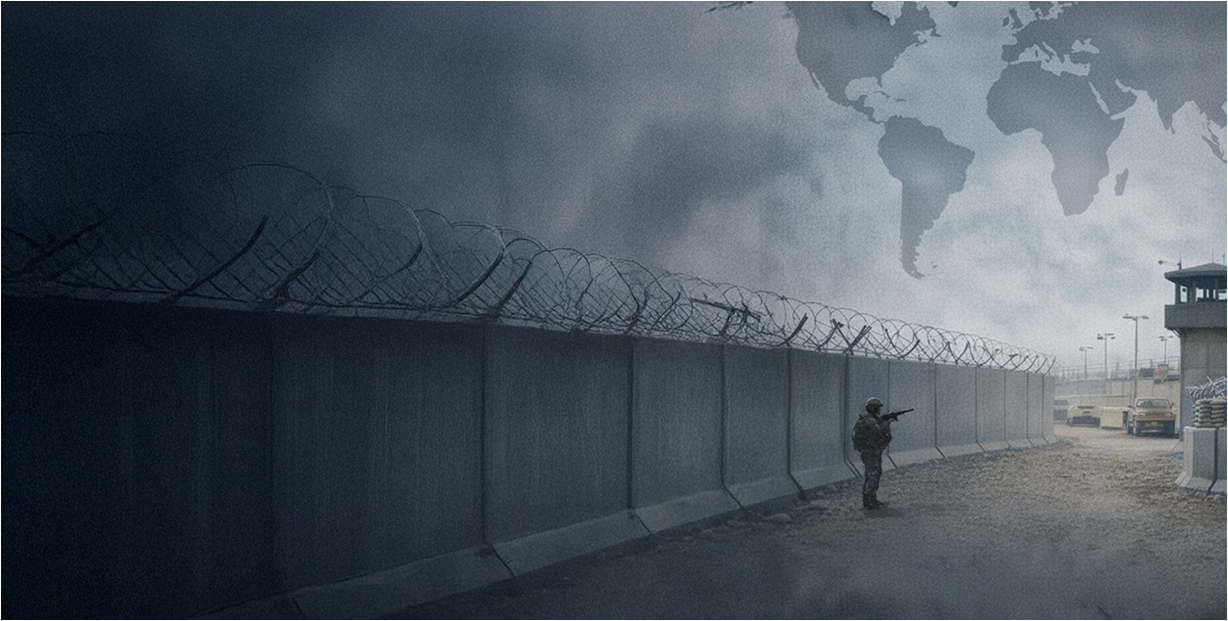
Prison Vagabonds by Mike Pannek is not just a study of corrections systems—it feels like sitting down with someone who has actually lived inside them. Through firsthand experiences across military service, prison environments, and international reconstruction missions, the author walks the reader through a world most people never see.
From domestic corrections work to rebuilding broken systems in post-war zones like Iraq and Afghanistan, the narrative is grounded in real moments—dangerous, uncertain, and often deeply human. Instead of theory, the book speaks through lived reality.
Here are five powerful lessons you learn directly through his experiences.
1. Prison Systems Sit at the Center of Global Security
The author repeatedly shares how he learned this after stepping into international correctional work.
In his experience, prisons were not isolated institutions—they were deeply tied to national stability. While working in post-2003 Iraq, he describes walking into facilities that had completely collapsed after the fall of Saddam Hussein’s regime. Walls were damaged, records were gone, staff were untrained, and control barely existed.
In those conditions, he realized something critical: if prisons are unstable, the malign ideologies and behaviors within will eventually spread into the external society over time. Prison can be a schoolhouse for criminality and extremism.
Working within programs like the International Criminal Investigative Training Assistance Program (ICITAP), he saw how rebuilding correctional systems was just as important as rebuilding roads or governments. In his words, through experience, security doesn’t end at checkpoints—it continues inside prison walls.
2. Rehabilitation Is Not an Idea—It Is a Responsibility
One of the strongest realizations he shares comes from observing inmates and systems up close.
Early in his career, prisons felt like systems built mainly for control. Over time, especially in international environments, he saw how that approach alone failed. Without a structure for rehabilitation, prisons became places where frustration, extremism, and violence often grew stronger.
He describes moments where he saw the difference between a chaotic facility and one where training, discipline, and structured programs were introduced. Even small changes—like officer training or basic procedure systems—started shifting behavior inside the facility.
Through these experiences, he came to understand that corrections is not just about holding people—it is about shaping outcomes.
3. Positive Change Only Happens in Stable Conditions
Much of the book is shaped by his time in post-war Iraq, where he stepped into environments that were still actively unstable.
He describes situations where plans changed without warning, movement between locations required caution, and every day carried uncertainty. Mortar attacks, security threats, and sudden disruptions were part of the environment—not exceptions to it.
Yet, in his experience, this is exactly where transformation begins.
He shares how rebuilding a prison system was never a smooth process. It was slow, repetitive, and often frustrating. Training sessions had to be repeated and reinforced. Systems had to be rebuilt from scratch. Trust had to be earned step by step.
The lesson he carries forward is that productive change is rarely comfortable—it grows amid chaos, not outside it. It demands thoughtful objectives, detailed planning and consistent follow-through.
4. Corrections Work Is One of the Most Misunderstood Professions
Throughout the book, the author reflects on how little the outside world understands corrections work.
He shares firsthand experiences of riots, threats, overcrowded facilities, and constant tension. In those environments, decisions had to be made quickly, often under pressure, where mistakes could have serious consequences.
What stayed with him most was not just the danger, but the responsibility.
He worked alongside officers and advisors who operated in extremely difficult conditions, often without recognition. In his experience, they were professionals holding unstable systems together with discipline and consistency.
The deeper realization he shares is that corrections officers are not just managing prisons—they are managing stability itself.
5. Prisons Can Shape Either Radicalization or Recovery
One of the most important lessons he learned came gradually, through international assignments across Iraq, Afghanistan, Indonesia, Kosovo, and the Philippines.
He observed a repeating pattern: prisons without structure often became environments where extremist ideas could grow. Overcrowding, lack of control, and poor management created spaces where malign influence and ideology spread easily.
However, he also saw the opposite.
When systems were properly organized—when officers were trained, procedures were followed, and rehabilitation was taken seriously—prisons became spaces where individuals could actually change direction in life. From his perspective, this was one of the most important discoveries of his career: prisons are not just endpoints, they are turning points.
To Conclude
Prison Vagabonds reads like a collection of lived moments rather than distant analysis. The author doesn’t just explain correctional systems—he takes the reader inside them, showing what it feels like to stand in unstable environments, rebuild broken systems, and make decisions that carry real consequences. Through his experiences, one message becomes very clear:
Global security is not only shaped in war zones or political offices—it is also shaped quietly inside prison walls, where stability is built one decision at a time.
Give Prison Vagabonds A Read Today!
If these lessons resonate with you, go deeper into the journey itself. Read the book Prison Vagabonds and experience the real stories, the real challenges, and the real moments that shaped a world most people never get to see.